

Where to find this: Dashboard → Website Builder → Settings (gear icon)
Why these settings matter
When someone shares your website on Facebook, LinkedIn, or iMessage, what do they see? When parents have 20 browser tabs open, can they find your site? These seemingly small details create a professional impression that builds trust. Favicon: The small icon that appears in browser tabs, bookmarks, and mobile home screens Share Image (Open Graph): The preview image that appears when your pages are shared on social media or messaging appsGetting these right means your coaching business looks established and professional - not like a hobby project someone started yesterday.
Setting up your favicon
Your favicon is the tiny icon that represents your website everywhere browsers display it:- Browser tabs
- Bookmarks bar
- Browser history
- Mobile home screen (when saved)
1
Open Website Settings
From your Website Builder, click the Settings gear icon in the left sidebar.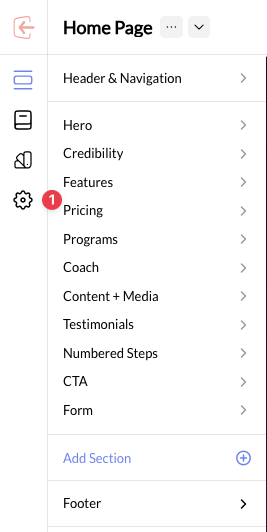
2
Upload Your Favicon
In the Settings panel, find the Add Favicon section at the top. Click Select Media to choose or upload your icon.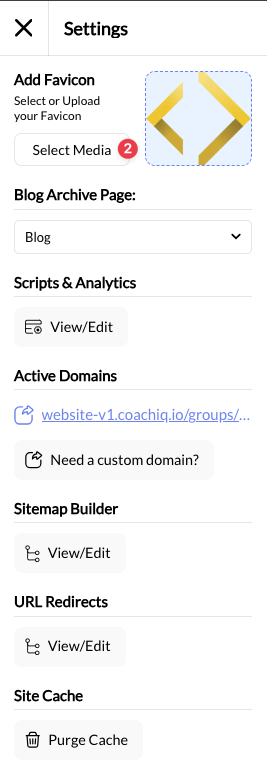
3
Preview and Publish
After selecting your image, click Publish to make your favicon live. It may take a few minutes for the change to appear in all browsers.
Favicon best practices
Do:- Use a simplified version of your logo
- Keep it recognizable at 16x16 pixels
- Use high contrast colors
- Test how it looks against both light and dark browser themes
- Use text (it’s too small to read)
- Use complex images with lots of detail
- Use your full logo with tagline
- Leave it as the default
Setting up share images (Open Graph)
Open Graph images are what people see when your website is shared on:- Twitter/X
- iMessage
- Slack
- Text messages with link previews
1
Select the Page to Edit
In the Website Builder, select the page you want to add a share image to from the dropdown menu.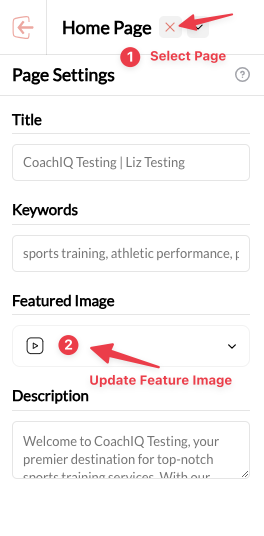
2
Open Page Settings
Click on any section, then look for the Page Settings panel on the left side. You’ll see fields for Title, Keywords, Featured Image, and Description.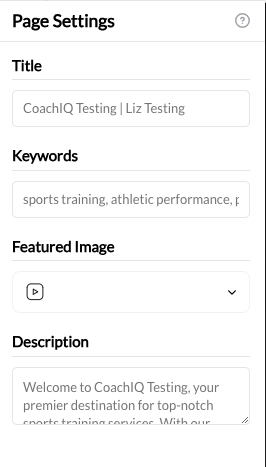
3
Add Your Featured Image
Click the Featured Image dropdown and select or upload an image. This becomes your Open Graph image - what appears when this page is shared.If a page has no Featured Image, it has no share image, and most apps show a text-only preview. Your site doesn’t fall back to a default picture, so add one to every page you plan to share.
4
Publish Your Changes
Click Publish to make your share image live.
Share image best practices
Image specifications:- Ideal size: 1200 x 630 pixels
- Minimum size: 600 x 315 pixels
- Format: JPG or PNG
- File size: Under 1MB for fast loading
- Include your logo or business name
- Use compelling visuals (action shots of training)
- Keep text minimal and large enough to read
- Use your brand colors for consistency
- Action shots from training sessions
- Your facility with logo overlay
- Team or group training images
- Before/after skill development photos
Page-specific SEO settings
While you’re in Page Settings, optimize these fields for each page:Title
The page title appears in:- Browser tabs
- Search engine results
- Social media shares
- Keep under 60 characters
- Include your location and primary service
- Put important keywords first
Description
The meta description appears in:- Search engine results
- Some social media shares
- Keep between 150-160 characters
- Include a clear value proposition
- Add a call-to-action
- Mention your location
Keywords
Target keywords help search engines understand your page content. Best practices:- Use 3-5 relevant keywords per page
- Include location-based terms
- Focus on what parents actually search for
- Avoid keyword stuffing
Quick checklist
Before launching or sharing your website:Favicon
- Uploaded custom favicon (not default)
- Recognizable at small sizes
- Published and visible in browser tab
Share Images
- Home page has featured image set
- Key landing pages have images
- Images are 1200x630 or larger
- Tested in Facebook debugger
Common questions
Why isn't my new favicon showing up?
Why isn't my new favicon showing up?
Browsers cache favicons aggressively. Try:
- Hard refresh (Cmd+Shift+R on Mac, Ctrl+Shift+R on Windows)
- Clear your browser cache
- Open the site in an incognito/private window
- Wait 24 hours for DNS caches to update
What if I don't have a logo?
What if I don't have a logo?
Use a simple text-based image with your business name in your brand colors. Canva offers free templates for creating favicons and social share images.
Do I need different images for each page?
Do I need different images for each page?
Your home page definitely needs a share image. For other pages, it depends on whether you’ll share them directly. Camp registration pages, pricing pages, and program pages benefit from custom images.
What size should my favicon be?
What size should my favicon be?
Upload at 50x50 pixels or larger. CoachIQ will automatically generate the various sizes needed for different devices and browsers.