
What you’ll accomplish

By the end of this guide, you’ll have a fully configured scheduler that athletes can book. This is where your availability templates become actual bookable services that generate revenue.
Success criteria: Your scheduler is created, connected to availability, configured with rules, and generating bookable time slots that athletes can see and book.
New to schedulers? Read What Are Schedulers? first to understand the concepts. This article focuses on the practical creation steps.

Before you begin

Preparation makes creation faster and reduces errors: Have ready:
  • Clear idea of what service you’re offering
  • Decided on duration (30, 45, 60 minutes, or custom)
  • Decided on price (free, direct payment, or credits)
  • Availability already set up (or ready to create during this process)
  • 15-20 minutes of uninterrupted time
First scheduler recommendation: Start with your most common service type. For most coaches, this is a 60-minute private session at your standard rate. Get this working first before adding complexity.

The scheduler builder sections overview

Before diving in, understand what you’ll configure: Required sections (must complete):
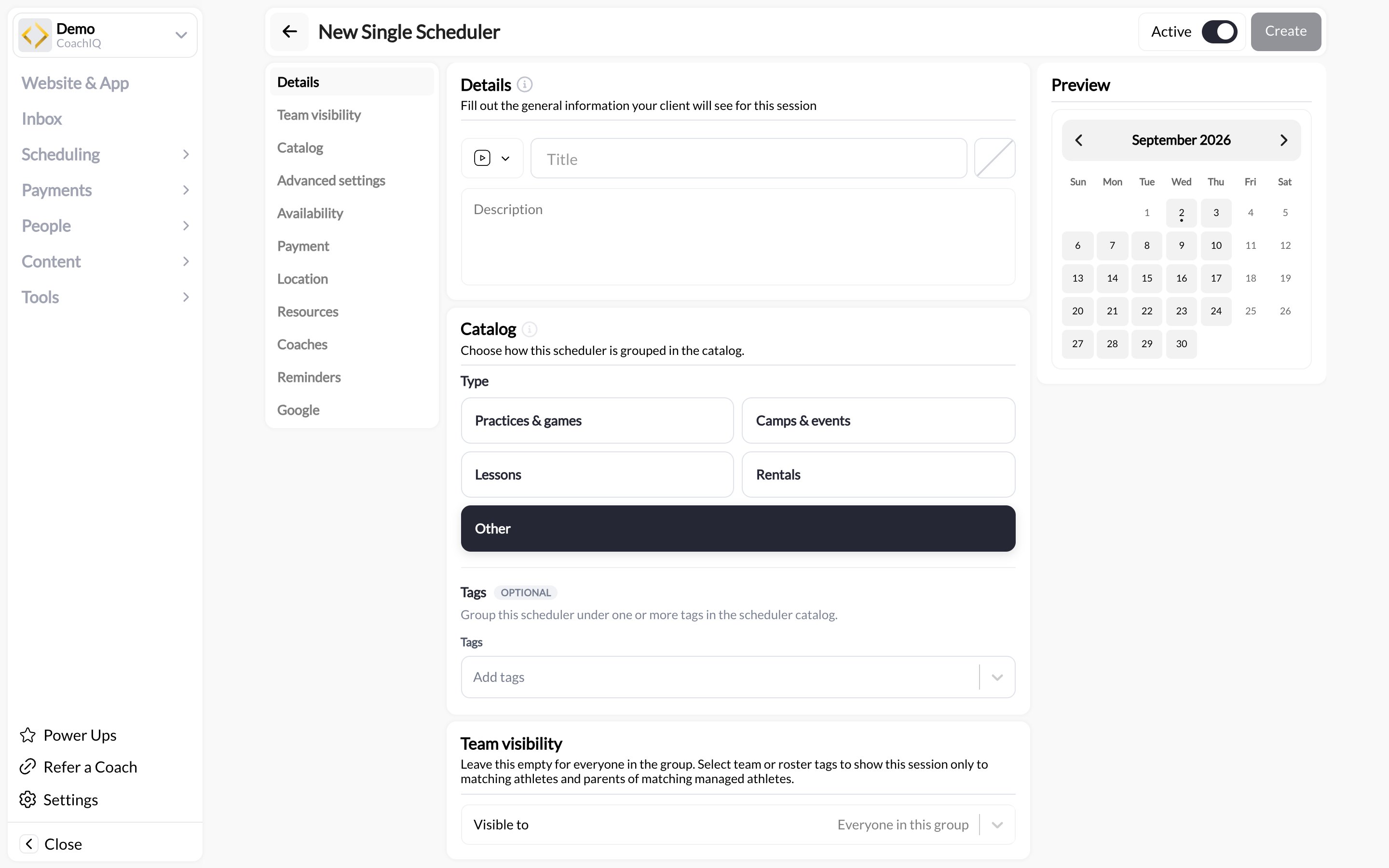
  1. Basic Details - Name, description, duration
  2. Availability - When this scheduler can be booked
  3. Payment - Free, paid, or credit-based
  4. Capacity - How many athletes per session
Optional sections (can skip initially):
  1. Booking Rules - Limits, permissions, cancellation policies
  2. Buffer Time - Breaks between sessions
  3. Scheduling Windows - Minimum notice, maximum future booking
  4. Reminders - Automated notifications
  5. Location - Where sessions take place
  6. Connected Coaches - Who delivers this service
Phased approach: Complete required sections first to get a working scheduler. Return later to add optional features as needed.

Step 1: Navigate to scheduler creation

1

Access the Schedule section

From your CoachIQ dashboard:
  1. Click Schedule, then Schedulers in the main left navigation menu
2

Start creating new scheduler

Click the Create **New Scheduler **button
Create button options

Step 2: Configure basic session details

Start with the fundamentals that define what athletes are booking.
1

Enter scheduler name

Field: Session Name, Scheduler Name, or TitleWhat athletes see: This name appears prominently when they’re choosing what to book.Good naming examples:
  • “60-Minute Private Training”
  • “Small Group Strength Class”
  • “Free Initial Assessment”
  • “45-Minute Speed & Agility Session”
Include in name:
  • ✅ Format (ex: Private, Group, Semi-Private)
  • ✅ Key differentiator (ex: Skill Level)
  • ✅ Location
Avoid in name:
  • ❌ Internal codes (PT-60-A)
  • ❌ Overly generic (“Training Session”)
  • ❌ Too long (save details for description)
Scheduler Name Pn
Name testing: If you showed just the name to a stranger, would they understand what they’re booking? If not, make it clearer.
2

Add scheduler description

Field: Description, Details, or About This SessionPurpose: Explain what happens in this session, who it’s for, what athletes will learn/accomplish.What to include:
  • What happens during the session
  • Who this session is for (skill level, age, goals)
  • What athletes should bring or wear
  • What makes this valuable
  • Any prerequisites or requirements
Example description:
“One-on-one personalized training focused on your specific goals. We’ll work on technique, strength, conditioning, and sport-specific skills. Perfect for athletes of all levels looking to improve performance. Bring athletic shoes, water bottle, and workout clothes. Each session includes video analysis and personalized homework.”
Length guideline: 2-4 sentences is ideal. Enough to inform without overwhelming. Save very detailed information for your website or session materials.
3

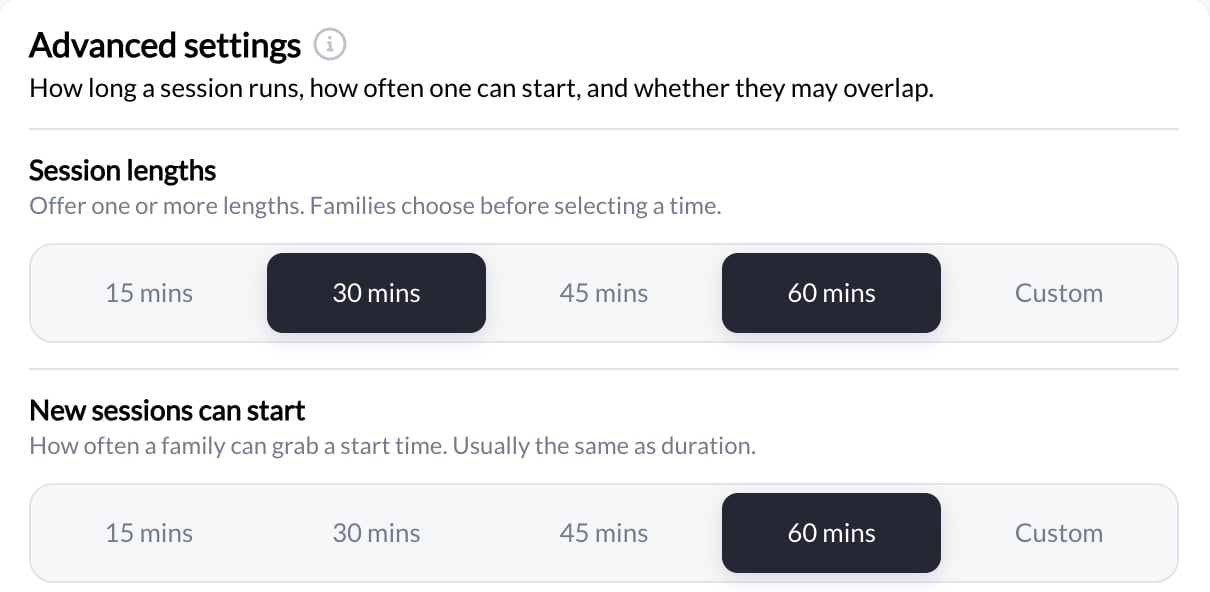
Set session duration

Field: Duration, Session Length, or TimeOptions typically:
  • 60 minutes (standard training, most common)
  • 90 minutes (extended training)
  • 120+ minutes (one day clinics)
  • Custom (enter any duration)
For your first scheduler: 60 minutes is the safe default choice for most private training.
Duration impacts availability: A 60-minute session in a 5-hour availability window = ~5 bookable slots (accounting for buffer). Shorter sessions = more slots per day.
4

Review basic details

Before moving to next section, verify:
  • ✅ Name clearly describes the service
  • ✅ Description is compelling and informative
  • ✅ Duration matches your intended session length
These three fields are what athletes primarily see when deciding to book.

Step 3: Connect availability

This is where you define WHEN this scheduler can be booked.
1

Locate the Availability section

Scroll down in the scheduler builder to find:
  • Availability
  • Schedule
  • When You’re Available
  • Or similar section heading
Set Scheduler Availablity Pn
2

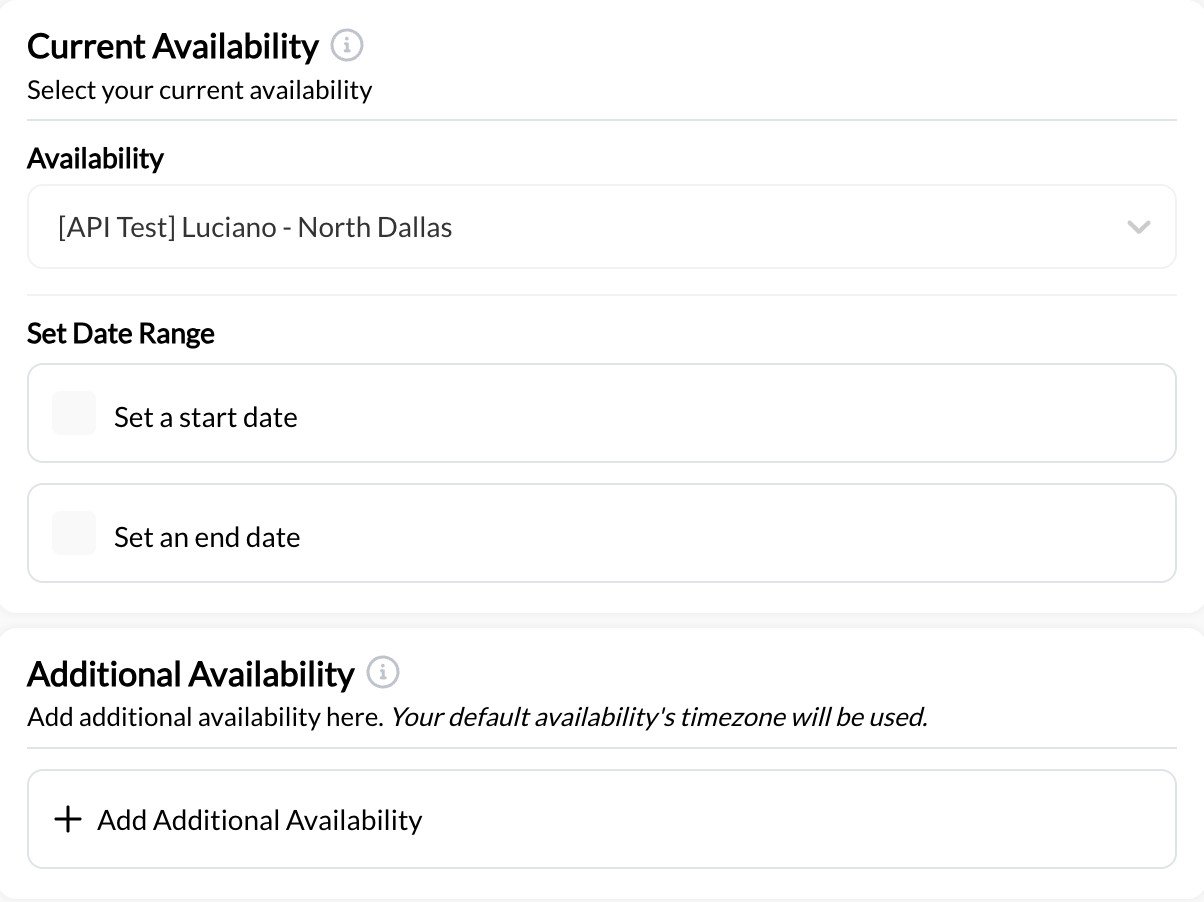
Choose availability

Select the drop menu and choose the corresponding availablity to attach to your scheduler
Reusability reminder: The availability you set here can power multiple schedulers. Think about it as your general coaching hours, not specific to this one service.
3

Set Start and End Dates (optional)

You can also customize start and end dates when clients can book with youGood to use if you’re:
  • Launching a new program
  • Switching to a new schedule after a certain date
Current Avaliabilty Pn
4

Add an Additional Availablity (optional)

If you need to attach another availability to your scheduler, you can select one from the Addtional Availability tab.Good to use if you’re:
  • Switching to a new schedule at a later date
Additional Availability Pn

Step 4: Configure payment settings

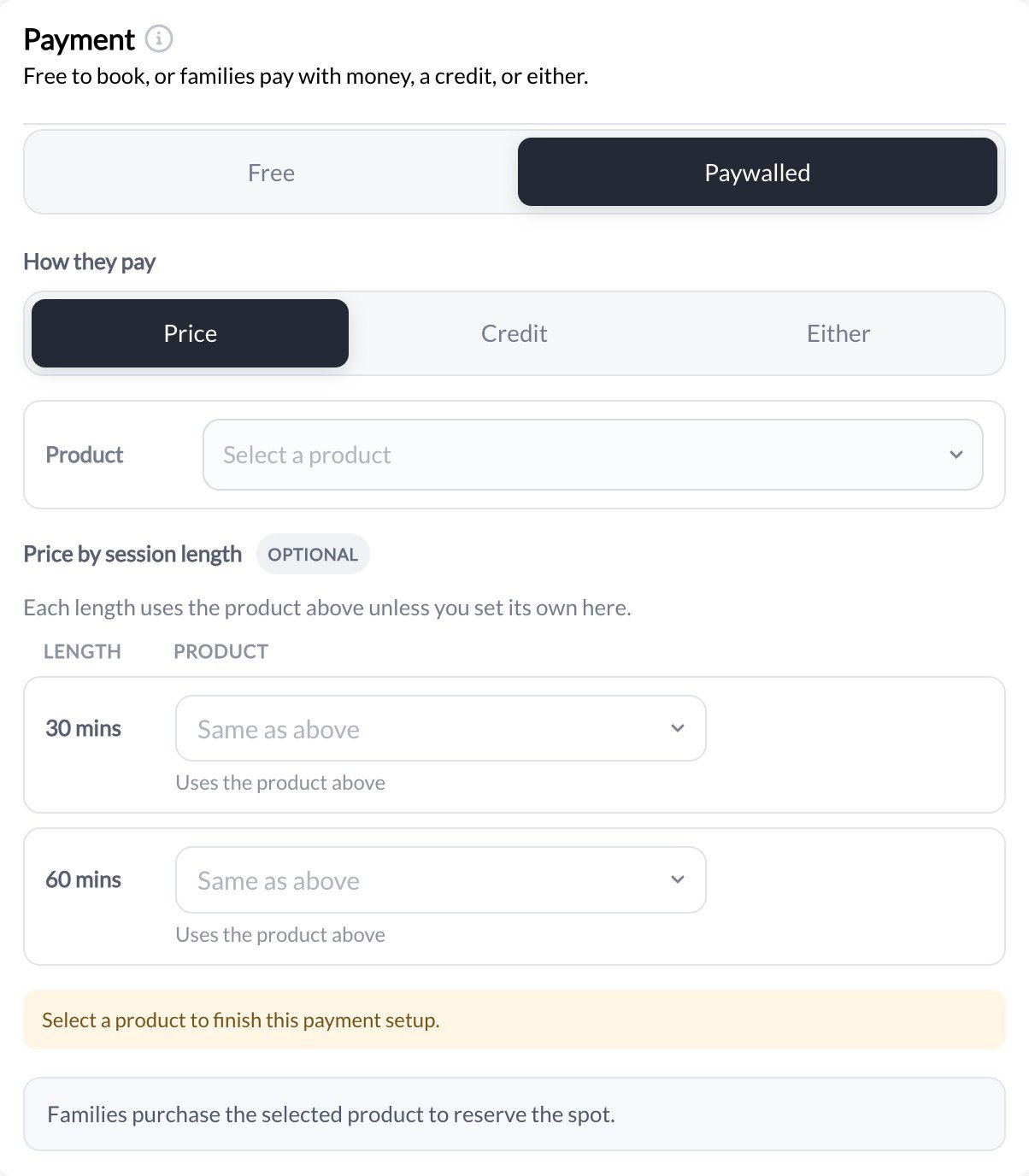
Decide how athletes will pay for this scheduler.
When to use:
  • Trial/assessment sessions
  • Team practices
  • Makeup sessions
  • Building relationships
How to set up:
  1. Find payment section
  2. Select Free
Result: Athletes can book without any payment or credits.
First scheduler tip: If this is your very first scheduler and you’re still learning, start with FREE. You can always change to paid later once you’re comfortable with the system.

Step 5: Set capacity and participant limits

Control how many athletes can book. Options:
  • Max booking per day: limit on the number of bookings in a day
  • Max bookings per week: limit on the number of bookings in a week
  • Max athletes per session (most common): limit on the number of athletes in a session
Common settings for max athletes per session:
  • 1 athlete = Private 1-on-1 sessions (most common for first scheduler)
  • 2 athletes = Semi-private training
  • 3-6 athletes = Small group sessions
  • 8-12 athletes = Medium group classes
  • 15-20+ athletes = Large group classes or team training
Capacity impacts pricing: If setting capacity >1, consider per-athlete pricing. 40 per athlete × 6 athletes = 40 _per athlete _×6 _athletes _= 240 per session (much more valuable than 1-on-1 at $75).
These settings control how athletes can book and cancel.
Field: Allow Cancellations, Cancellation Policy, or similarOptions:
  • Allow anytime - Athletes can cancel up until session start
  • Require 24-hour notice - Can’t cancel within 24 hours
  • Require 48-hour notice - Can’t cancel within 48 hours
  • No cancellations allowed - Once booked, no cancellation
Credit refund settings (if using credits):
  • Refund credits on cancellation - Credit returns to athlete balance
  • No refund - Credit is consumed even if canceled
Recommended for first scheduler: “Allow cancellation with 24-hour notice, refund credits”Why: Prevents last-minute cancellations while being fair to athletes with legitimate conflicts.
Flexibility vs firmness: More flexible policies attract bookings but risk no-shows. Stricter policies protect your time but may discourage booking. Find your balance.
Purpose: Prevent athletes from over-bookingOptions:
  • Max bookings per day - Athlete can book max 1 (or 2, 3) per day
  • Max bookings per week - Athlete can book max 2 (or 3, 4, 5) per week
  • No limits - Athletes can book as many as they want
Recommended for first scheduler: Start with no limits unless you have specific reason to restrict.When to use limits:
  • High-demand schedulers with limited slots
  • Preventing single athlete from monopolizing schedule
  • Encouraging distribution across athlete base
Booking limits configuration
Setting: Can athlete book multiple future sessions at once?Options:
  • Yes - Athlete can book Monday, Wednesday, Friday all at once
  • No - Athlete must book one session at a time
Recommended: Yes (allow multiple bookings) for better athlete experienceWhy: Athletes with regular training schedules want to book their week at once, not one session at a time.
Settings: Who can book this scheduler?Options available in some systems:
  • All athletes - Anyone with account can book
  • Specific groups - Only athletes in certain programs
  • Invite only - You must enable access per athlete
  • Access codes - Athlete needs code to book
Recommended for first scheduler: All athletes (open access)When to restrict: VIP services, specialty programs, beta testing new offerings

Step 7: Add buffer time

Buffer time creates breathing room between back-to-back sessions.
1

Locate buffer time settings

Look for:
  • Buffer
Buffer Pn
2

Set buffer before session (optional)

Pre-session buffer: Time blocked before each session startsUse cases:
  • Setup time (equipment, training area)
  • Review athlete notes
  • Personal prep time
Typical setting: 5-10 minutesMost coaches skip this for their first scheduler.
3

Set buffer after session (highly recommended)

Post-session buffer: Time blocked after each session endsUse cases:
  • Cleanup time
  • Bathroom break
  • Notes and documentation
  • Transition between athletes
  • Sessions running slightly over
Typical setting: 10-15 minutesRecommended for first scheduler: 15 minutes
Buffer is invisible to athletes: They only see available booking times. The buffer time happens automatically between sessions but doesn’t appear on their booking screen.
4

Understand buffer impact

Without buffer (back-to-back):
  • 3:00-4:00 PM (Session 1)
  • 4:00-5:00 PM (Session 2)
  • 5:00-6:00 PM (Session 3)
With 15-min buffer:
  • 3:00-4:00 PM (Session 1)
  • 4:15-5:15 PM (Session 2)
  • 5:30-6:30 PM (Session 3)
Result: Proper spacing, no burnout, accommodation for sessions running over.
Verify: Your availability end time accounts for buffer after last session. If last session starts at 7:00 PM (60 min) + 15 min buffer = need availability until 8:15 PM.

Step 8: Set scheduling windows (optional)

Control how far in advance (or how last-minute) athletes can book.
Setting: Earliest time before session when booking is allowedOptions:
  • No minimum - Can book right up to start time
  • 1 hour - Must book at least 1 hour before
  • 4 hours - Must book at least 4 hours before
  • 24 hours - Must book at least 24 hours before
  • 48 hours - Must book at least 48 hours before
Recommended for first scheduler: No minimum OR 4 hoursWhy use minimum notice:
  • Prevents last-minute bookings when you can’t prepare
  • Ensures you see bookings before they happen
  • Reduces stress of surprise bookings
Why skip minimum notice:
  • Maximizes booking flexibility
  • Good for urgent/emergency sessions
  • Simpler for athletes
Start flexible, add restrictions later: Begin with no minimum and add restrictions only if last-minute bookings become problematic.
Setting: How far in the future athletes can bookOptions:
  • No limit - Can book months/years ahead
  • 30 days - Can only book within next month
  • 60 days - Can book up to 2 months ahead
  • 90 days - Can book up to 3 months ahead
Recommended for first scheduler: 30-60 days OR No limitWhy use maximum window:
  • Prevents schedule from filling too far out
  • Allows flexibility to adjust pricing/availability
  • Keeps bookings manageable
Why skip maximum window:
  • Accommodates athletes who plan far ahead
  • Good for seasonal businesses
  • Maximizes booking opportunities
Most coaches: Either set no limit or 30-60 days. Very few use shorter windows unless there’s specific reason.

Step 9: Configure reminders (optional but valuable)

Set up automated notifications before sessions to reduce no-shows.
1

Enable reminders

Look for Reminders toward the bottom of the scheduler settings
Reminders UI Pn
2

Set reminder timing

Choose when reminder is sent before session:
  • 30 minutes - Last-minute reminder
  • 1 hour - Short-notice reminder
  • 2 hours - Moderate notice
  • 1 day - Day-before reminder (most common)
  • 2 days - Advance notice
  • Custom - Any timing you specify
Recommended for first scheduler: 1 day before (24 hours)Why: Gives athletes enough time to cancel or prepare, without being too early to forget again.
Multiple reminders: Some coaches set both 1-day and 1-hour reminders for important sessions. Start with just one for simplicity.
3

Choose delivery method

How athletes receive the reminder:
  • In-App - Notification in CoachIQ app/portal and inbox
  • Announcement/Email - Sent to athlete’s email and in-app announcement feed
  • SMS - Text message to athlete’s phone (SMS rates apply)
Recommended for first scheduler: Announcement/EmailWhy: Maximum reach without SMS costs, covers both app users and email checkers.
4

Customize reminder message (optional)

Some systems let you customize the reminder text:Default message works fine:
“Reminder: You have a session tomorrow at 3:00 PM with Coach Mike”
Custom message example:
“Your training session is tomorrow at 3:00 PM! Please bring your workout gear, water bottle, and be ready to work. See you soon!”
Start with default: Custom messages are nice-to-have, not critical for first scheduler. Default messages work perfectly well.

Step 10: Add location (optional)

Specify where this session takes place.
1

Locate location section

Find Location:
Location Scheduler Ui Pn
2

Select or create location

If location exists:
  • Select from dropdown of existing locations
If creating new location:
  1. Click Add New Location
  2. Enter location name (ex: “Main Training Facility”)
  3. Enter address (optional but helpful for athletes)
  4. Add notes (ex: “Use side entrance, check in at front desk”)
  5. Save location
Virtual sessions: If sessions are virtual, create location called “Virtual Session” or “Online via Zoom” with video link in notes.
3

Specify if location is required

Some schedulers may not need location:
  • Video analysis (you watch film together remotely)
  • Programming consultation (virtual)
  • Flexible location (meet at athlete’s preferred gym)
Toggle “No specific location” if applicable.

Step 11: Assign coaches (if applicable)

Specify which coach(es) deliver this scheduler.
1

Find connected coaches section

Look for Connected Coaches
Connected Coaches Ui Pn
2

Select coach(es)

Solo coach: Select yourselfMulti-coach facility:
  • Select specific coach if this scheduler is coach-specific
  • Select multiple coaches if any can deliver this session
If you’re solo: You can skip this section or select yourself. Most solo coaches leave this at default.
3

Set overlapping booking permission

Setting: Can this coach be booked for multiple sessions at same time?Options:
  • No - Prevent double-booking (recommended)
  • Yes - Allow overlapping bookings (only for group sessions where coach leads multiple)
Recommended: No (prevent double-booking) unless you specifically need overlap for group classes.

Step 12: Review and save

Final checks before activating your scheduler.
1

Review all configuration

Scroll through the entire scheduler and verify:Basic Details:
  • ✅ Name is clear and descriptive
  • ✅ Description is compelling
  • ✅ Duration is correct
Availability:
  • ✅ Days and times match your schedule
  • ✅ Blackout days added for known time off
  • ✅ End time accounts for buffer after last session
Payment:
  • ✅ Payment type matches intent (free/paid/credits)
  • ✅ Price is correct
  • ✅ Product connected (if direct payment)
Capacity:
  • ✅ Max athletes setting matches session format
  • ✅ Group vs private is correct
Optional Settings:
  • ✅ Buffer time set (15 min recommended)
  • ✅ Booking rules configured (if needed)
  • ✅ Reminders enabled (1 day before recommended)
  • ✅ Location added (if needed)
2

Save your scheduler

Click **Create **in the top right hand corner
Success! Your scheduler is now created and will start generating bookable time slots.
3

Note your scheduler details

After saving, you’ll be taken to the Schedulers list.Find your newly created scheduler and note:
  • Scheduler name
  • Duration (mins)
  • Cost per session (free, price, credit charge)
  • Booking link
Schedulers Overview Pn

Step 13: Test your scheduler

Critical step: Always test your scheduler before sharing with athletes. This catches configuration errors before they cause problems.
1

Get your booking link

From the Schedulers list:
  1. Hover over your new scheduler
  2. Look for Copy Link button
  3. Copy the link
Scheduler Link Pn
2

Open booking link as athlete would

Paste the link into a new browser tab (or incognito window to see unauthenicated view).What you should see:
  • Scheduler name and description
  • Price or credit cost
  • Duration clearly stated
  • Available time slots listed
  • Booking button or time selection
Scheduler Athlete View Pn
3

Verify available time slots appear

Check that:
  • ✅ Days match your availability configuration
  • ✅ Times are correct (not AM when you meant PM)
  • ✅ Proper number of slots appear
  • ✅ Slots are spaced correctly (accounting for buffer time)
  • ✅ No inappropriate times showing
If no slots appear: Your availability isn’t configured correctly. Go back and verify availability days/times are set, and date range extends into the future.
4

Test booking a session (if possible)

If you have a test athlete account:
  1. Select an available time slot
  2. Go through the booking process
  3. Complete payment or credit redemption
  4. Verify booking confirmation appears
  5. Check that session appears on your calendar
If you don’t have test athlete:
  • At minimum, verify slot selection works
  • Check that booking button appears
  • Verify payment/credit information displays correctly
5

Check your calendar

Navigate to Schedule → Calendar:
  • ✅ Test booking appears (if you completed test)
  • ✅ Time displays correctly
  • ✅ Scheduler name shows on booking
Calendar showing scheduler availability and test booking
Testing complete: Your scheduler is working correctly and ready for real athlete bookings.

Troubleshooting common creation issues

Possible causes:
  • Required fields not completed
  • Invalid data in fields (negative numbers, etc.)
  • System validation error
How to fix:
  1. Scroll through entire form
  2. Look for red error messages or highlighted fields
  3. Most common missing items:
    • Scheduler name
    • Duration
    • Availability (no days/times set)
    • Payment configuration incomplete
  4. Complete all required fields marked with * or red indicators
  5. Try saving again
Most common issue for new schedulers!Possible causes:
  1. No availability set - Forgot to add days/times
  2. Availability in past - End date already passed
  3. All dates blocked - Blackout days covering everything
  4. Buffer time too long - Consuming entire availability window
How to fix:
  • Edit scheduler → Availability section
  • Verify days are checked
  • Verify time ranges are set
  • Verify date range includes future dates
  • Check blackout days aren’t blocking everything
  • Calculate: (Availability hours) ÷ (Duration + Buffer) = Expected slots
    • Example: 5 hours ÷ 1.25 hours (60 min + 15 min) = 4 slots expected
Quick test: Remove all buffer time temporarily. If slots appear, buffer was consuming availability. Adjust accordingly.
Issue: Slots showing 3:00 AM when you meant 3:00 PMCause: 12/24-hour time format confusionHow to fix:
  • Edit scheduler → Availability
  • Check all time fields
  • Verify AM/PM selections
  • Or switch to 24-hour format (15:00 instead of 3:00 PM) if available
  • Save and re-test
Issue: Product dropdown is empty or not connectingPossible causes:
  1. No products exist yet
  2. Product type mismatch (looking for one-time, only subscriptions exist)
  3. Payment processor not connected
How to fix:
  1. Go to Payments → Products
  2. Verify products exist
  3. Create new product if needed:
    • Name: Match your scheduler name
    • Type: One-time purchase (for direct payment)
    • Price: Match your intended rate
  4. Return to scheduler builder
  5. Select newly created product
Issue: Booking button disabled or error when athlete tries to bookPossible causes:
  1. Insufficient credits (if credit-based)
  2. Payment processing error (if direct payment)
  3. Capacity full (unlikely for brand new scheduler)
  4. Booking limits reached (if configured)
How to debug:
  • Test as athlete (what error message appears?)
  • Verify payment processing is set up
  • Check if test athlete has credits (if credit-based)
  • Review booking limit settings
  • Check scheduler status (Active/Published?)

What to do after creating your first scheduler

Share with Athletes

Copy your booking link and share via:
  • Email to current athletes
  • Social media
  • Website embedding
  • SMS/messaging apps

Create More Schedulers

Now that you’ve created one, add more:
  • Different durations (30 min, 90 min)
  • Different formats (group sessions vs private sessions)
  • Different services (assessments, consultations)

Set Up Payment

If you started with FREE, add payment:
  • Edit your scheduler
  • Change to direct payment or credits
  • Connect products
  • Test purchase flow

Organize Schedulers

As you add more schedulers, organize them:
  • Use program groupings
  • Create logical categories
  • Improve athlete booking experience by keeping things simple and clean
Questions about scheduler configuration? Our support team can help you set up schedulers optimized for your coaching business. Contact Support